In twenty years of running a 700-plus asset biomedical department, I’ve learned where NABH assessments are actually won and lost — and it isn’t the policy binder. It’s the equipment. When an assessor walks your ICU, picks up a ventilator and asks to see its calibration certificate, its last preventive-maintenance record and the training record of the nurse operating it, that thirty-second exchange tells them more about your quality system than a hundred pages of documentation.
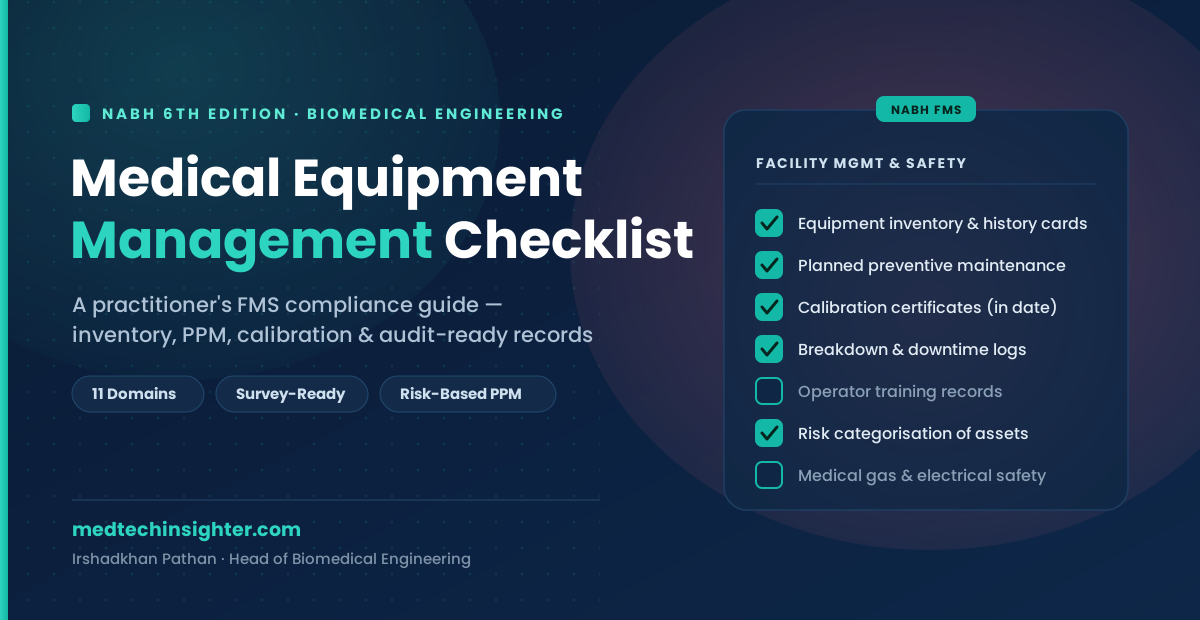
This is a practitioner’s checklist for NABH medical equipment management — built from the floor, not from the standard book. It maps to the current 6th Edition (HCO 6.0) requirements and is written to survive a real survey.
Where equipment management sits in NABH 6th Edition
First, the thing most hospitals get wrong about timing: the 6th Edition is now the applicable standard. NABH released HCO 6.0 in January 2024, and the 5th-edition pathway is closed for new applicants — first-time hospitals must target the 6th edition, and hospitals on an existing cycle transition at their next full renewal. If your documentation still references the 5th edition, that’s the first gap to close.
Medical equipment management lives in Chapter 8 — Facility Management and Safety (FMS), under FMS.8: “the organization has a program for medical equipment management.” The adjacent utility and medical-gas requirements sit in the same chapter. The core shift in the 6th edition matters here: it moved from a documentation-heavy model toward an outcomes and patient-safety focus. In plain terms, it’s no longer enough to have a PPM schedule — the assessor wants evidence it’s actually keeping equipment safe and available. Records are necessary but no longer sufficient; results are what’s assessed.
Keep one more thing in mind: objective elements carry compliance levels, and CORE objective elements must score highly (at least 4 on NABH’s scale). Equipment safety elements are exactly the kind that are treated as CORE — so partial compliance here is a genuine risk to the whole accreditation, not a minor observation.
Table of Contents
The NABH Medical Equipment Management Checklist
Work through these eleven domains. Each is something an assessor can and does verify on the floor. I’ve flagged where hospitals most often lose marks.
1. Equipment inventory & documentation
- A complete, current inventory of all medical equipment exists and is reconciled with physical assets.
- Every asset has a unique identification tag/code physically on the device.
- Each asset has an equipment history card (or digital equivalent) capturing purchase, installation, warranty, service history and calibration.
- Inventory records make/model, serial number, location/department, and date of commissioning.
- Equipment is risk-categorised by criticality (this directly supports your maintenance planning — see Section 6).
2. Planned preventive maintenance (PPM)
- A documented PPM schedule exists for every applicable asset, with defined frequency.
- PPM is actually performed on schedule, and completed work orders are signed and dated.
- PPM frequency is justified — manufacturer recommendation or a documented risk-based rationale (NABH accepts risk-based schedules when they are documented).
- PPM compliance is tracked as a metric (scheduled vs completed), not just filed.
- Missed PPMs have a documented reason and corrective action.
3. Calibration — the #1 nonconformance
This is where more hospitals fail than anywhere else in equipment management. Missing or expired calibration records are the single most common major nonconformance in NABH surveys. Treat this section as non-negotiable.
- All measuring/clinical equipment requiring calibration is identified.
- Valid calibration certificates are on file and currently in date for each.
- Calibration is traceable to national/international standards (via an accredited lab or traceable internal process).
- A calibration due-date tracker flags expiries before they lapse.
- Equipment with failed/out-of-tolerance calibration is quarantined and actioned.
4. Breakdown (corrective) maintenance & downtime
- A documented process for reporting and logging breakdowns exists.
- Breakdown records capture fault, downtime duration, action taken and resolution.
- Downtime is tracked and reviewed — the 6th edition’s outcomes focus means uptime/availability is an expectation, not a bonus.
- Critical-equipment failures trigger a defined backup/contingency response.
5. Trained & authorised operators
- Staff operating equipment are trained and records prove it (user training, not just one-time induction).
- Competency is reassessed, especially for high-risk devices.
- New-equipment installation includes documented user and biomedical staff training.
- Operating instructions are available at the point of use.
6. Risk categorisation of equipment
The 6th edition’s risk lens runs through the whole chapter. A documented criticality classification lets you defend why a ventilator is maintained differently from a waiting-room monitor — and assessors respond well to a rational, risk-based program.
- Equipment is classified (e.g. critical / high / medium / low) against defined criteria.
- Maintenance intensity and spare-holding reflect that classification.
- The classification is reviewed periodically and after incidents.
I’ve written separately on building this out properly in medical equipment risk assessment — a risk-scored inventory is the backbone an assessor-friendly program is built on.
7. Medical gas pipeline & utility-linked equipment
- Piped medical gas system documentation is current: pressure logs, alarm testing records.
- Medical gas alarms are tested and the tests recorded.
- Backup supply (manifold/cylinders) and changeover are verified.
- Utility-dependent equipment has a defined response to power/supply failure.
8. Electrical safety
- Electrical safety testing is performed on applicable equipment and recorded.
- Equipment showing electrical faults is removed from service until cleared.
- Earthing/leakage checks are part of PPM for relevant devices.
9. AMC / CMC contract management
- All service contracts (AMC/CMC) are inventoried with scope and validity.
- Contract expiries are tracked and renewed before lapse.
- Vendor visit reports are filed against the equipment history card.
- Critical equipment without a contract has a documented service arrangement.
10. Incident reporting & device recalls (materiovigilance)
As MvPI Coordinator at my hospital, I’ll say plainly: this is an under-built area in most equipment programs, and the 6th edition’s patient-safety focus makes it increasingly visible.
- A process exists to report equipment-related adverse events and near-misses.
- Staff know how to report a device malfunction that harmed or could have harmed a patient.
- The hospital participates in / is aware of the Materiovigilance Programme of India (MvPI) for device adverse-event reporting.
- Manufacturer recalls and field-safety notices are tracked and acted upon.
11. Decommissioning & condemnation
- A documented process governs condemnation/decommissioning of end-of-life equipment.
- Decommissioned assets are removed from the live inventory and physically segregated.
- Disposal follows applicable regulations (including e-waste/biomedical where relevant).
The documents an assessor will actually ask for
If you prepare nothing else, prepare these. This is the short list surveyors reach for first:
- The medical equipment management program/plan document (your FMS.8 policy).
- The equipment inventory with risk categorisation.
- Equipment history cards for sampled assets.
- PPM schedule + completed PPM records for those assets.
- In-date calibration certificates for sampled measuring equipment.
- Breakdown/downtime logs with resolution.
- Staff training/competency records for operators of sampled devices.
- Medical gas pressure/alarm test records.
- AMC/CMC contracts and vendor reports.
- Evidence the program is reviewed — minutes, metrics, corrective actions.
The pattern to notice: an assessor samples an asset and traces it end to end — inventory → history card → PPM → calibration → operator training. If any link is missing for the device in their hand, it’s a finding. Your program is only as strong as its weakest asset’s paper trail.
The three failures that cost hospitals most
From surveys I’ve seen and prepared for, the recurring losses are predictable:
Expired calibration. Certificates exist but lapsed. The fix is a due-date tracker that alerts before expiry, not an annual scramble.
PPM done but not evidenced. The work happened; the signed, dated record didn’t. In an outcomes-focused edition, unrecorded work is treated as work not done.
One-size-fits-all maintenance with no rationale. Flat schedules with no risk logic read as an unmanaged program. A documented risk classification turns the same effort into a defensible system.
Every one of these is an administration and tracking problem, not an engineering one — which is exactly why they’re solvable before your next survey.
Making it sustainable: from binder to living system
Here’s the uncomfortable truth about a paper-based equipment program at 700-plus assets: it is almost impossible to keep audit-ready by hand, year-round, between surveys. Calibration dates drift, PPMs slip, contracts lapse — not from negligence but from volume.
This is why I moved our own program toward a risk-scored, digitally tracked system — the same thinking behind reducing equipment downtime with AI and the predictive maintenance work I’ve documented here. When every asset carries a live risk score, a calibration due-date and a PPM status in one place, NABH compliance stops being a pre-survey project and becomes a byproduct of running the department well. That’s the real goal: not passing the survey, but being the kind of department that would always pass.
Frequently Asked Questions
Which NABH standard covers medical equipment management?
Medical equipment management falls under Chapter 8, Facility Management and Safety (FMS), specifically FMS.8 — “the organization has a program for medical equipment management.” Medical gas and utility requirements sit in the same chapter.
Which NABH edition is currently applicable?
The 6th Edition (HCO 6.0), released in January 2024. First-time applicants must use the 6th edition; hospitals on an existing accreditation cycle transition at their next full renewal.
What is the most common equipment-related NABH nonconformance?
Missing or expired calibration records are the single most common major nonconformance in equipment management. A calibration tracker that flags expiries before they lapse is the highest-value fix.
Does NABH allow risk-based maintenance instead of fixed schedules?
Yes — NABH accepts risk-based maintenance frequencies when the rationale is documented. A defensible risk classification of your inventory is what makes this acceptable to an assessor.
How often is NABH accreditation renewed?
NABH accreditation is valid for three years, with annual surveillance (self-assessment) in between. Compliance criteria tighten at surveillance and re-accreditation.
What documents should a biomedical department keep survey-ready?
At minimum: the equipment management program, risk-categorised inventory, equipment history cards, PPM schedules and records, in-date calibration certificates, breakdown/downtime logs, operator training records, medical gas test records, and AMC/CMC contracts.
Conclusion: Equipment Management is a quality system, not a filing exercise
NABH’s 6th edition made one thing clear — the question is no longer “do you have the records?” but “is your equipment demonstrably safe, available and well-managed?” For a biomedical department, that’s good news. It rewards the thing we should be doing anyway: running a risk-aware, well-evidenced, genuinely maintained estate. Work through the eleven domains above, fix the three common failures before they’re found, and build the tracking that keeps you audit-ready between surveys rather than scrambling before them.
I help hospitals build NABH-ready, risk-based biomedical equipment programs — from inventory and PPM systems to accreditation preparation. If that’s where your department is headed, get in touch.
Disclaimer: This checklist reflects practitioner experience and the structure of NABH 6th Edition requirements; always refer to the official standards at nabh.co for the authoritative, current objective elements applicable to your accreditation.