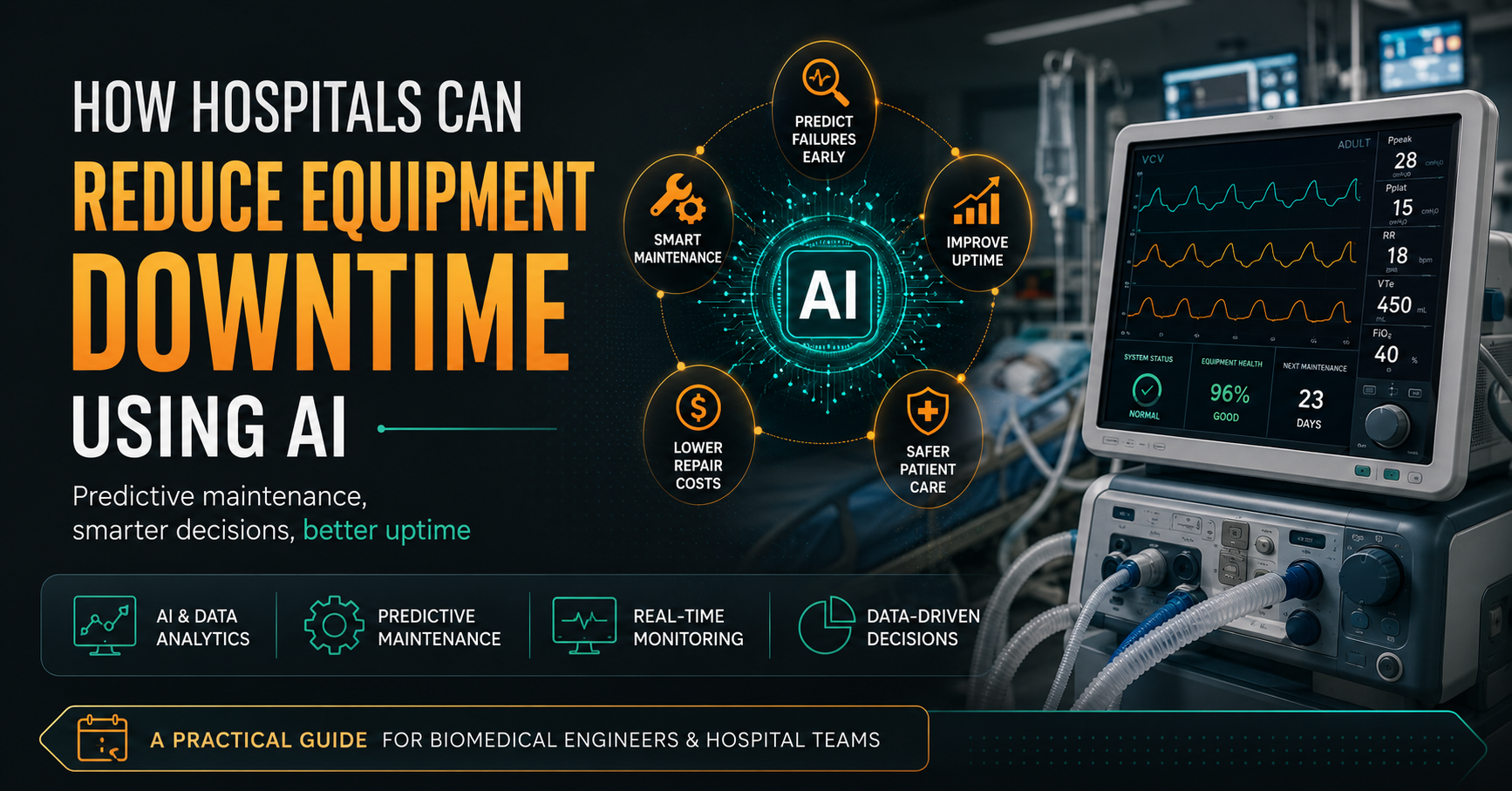
Introduction: Why Equipment Downtime Is a Hospital Crisis
In twenty years of working inside hospital biomedical departments, I have seen equipment downtime disrupt patient care in ways that rarely make it into management presentations. A ventilator stops working at 2 AM in the ICU. A CT scan machine goes down on a Monday morning with fifteen patients already scheduled. An infusion pump throws an alarm that no one has seen before, and the clinical staff calls the biomedical department in a panic.
These are not rare events. They happen every week in hospitals across the world, and they carry real consequences — delayed diagnosis, postponed surgeries, patient transfers, and emergency repair costs that were not budgeted for. The good news is that modern technology now gives hospitals a practical way to reduce equipment downtime using AI-based tools and data analysis methods that were simply not available a decade ago.
This article is written specifically for biomedical engineers, hospital administrators, healthcare technology managers, and anyone responsible for keeping medical equipment running. You will not find generic AI marketing content here. What you will find is a practical, experience-based guide to using AI for hospital equipment maintenance — including how to start without expensive software, what data to collect, and how to present results to management.

Table of Contents
What Is Medical Equipment Downtime?
Before we go further, it is important to be precise about what we mean by medical equipment downtime. In the biomedical world, downtime falls into two categories:
Planned Downtime
Planned downtime is a scheduled period when equipment is intentionally taken out of service for PPM, calibration, software updates, or manufacturer-required inspection. When planned properly, clinical teams can arrange backup devices or reschedule procedures. For critical equipment like ventilators, dialysis machines, and anesthesia machines, a structured PPM schedule keeps downtime predictable and helps reduce equipment downtime using AI-driven maintenance planning.
Unplanned Downtime
Unplanned downtime is the dangerous kind. It happens without warning when equipment fails in the middle of clinical use. Consider these hospital examples:
- A patient monitor shuts down unexpectedly during a post-operative case in the recovery room.
- An infusion pump gives a repeated “occlusion” alarm that cannot be resolved, requiring the pump to be replaced mid-infusion.
- An MRI scanner develops a chiller fault, halting all MRI scans for two days while waiting for the vendor engineer.
- A dialysis machine reports a conductivity error that the biomedical team has not encountered before, requiring an emergency service call.
Unplanned downtime is expensive in every sense — financially, clinically, and reputationally. Hospitals need systems that catch failure signals before they become breakdowns. That is precisely where AI-based maintenance becomes valuable.
Why Equipment Downtime Happens in Hospitals
Over my career I have investigated hundreds of equipment failure incidents. The causes repeat themselves with remarkable consistency. Understanding them is the first step to preventing them.
1. Poor Preventive Maintenance Compliance
PPM schedules exist on paper in most hospitals. Actually completing them on time is a different story. Busy clinical schedules, shortage of biomedical staff, and lack of a tracking system mean that many PPMs are delayed or skipped. Syringe pumps, infusion pumps, and patient monitors in busy wards are notorious for missed PPMs.
2. High Equipment Utilization Without Rest Time
ICU equipment runs 24 hours a day, 7 days a week. Ventilators, bedside monitors, and infusion devices get minimal downtime. Manufacturers design these machines for high utilization, but without proper maintenance intervals, wear-and-tear accumulates faster than expected.
3. Aging Equipment With No Replacement Plan
Many hospitals operate equipment well beyond its recommended service life because CAPEX budgets are constrained. A ventilator that is nine years old with 45,000 hours of run time has a very different failure probability than a two-year-old machine. Without data tracking, this distinction is invisible to decision-makers.
4. Lack of Spare Parts in Inventory
When a breakdown happens, repair time is often stretched because critical spare parts are not stocked. Flow sensors for ventilators, pressure transducers for infusion pumps, and lamp assemblies for surgical lights are examples of parts that take days or weeks to procure if not maintained in inventory.
5. Vendor Response Delays
For equipment under AMC or CMC, the vendor’s response time is a major factor. A CT scanner down for three days is not uncommon when the vendor service engineer is committed to another hospital 200 km away. Without tracking vendor performance, this pattern continues without accountability.
6. User Handling Issues
Improper use by clinical staff is a significant but often underreported cause. Repeated alarm suppression, incorrect parameter settings on anesthesia machines, and improper cleaning of endoscope equipment are examples that biomedical teams encounter regularly.
7. Environmental Conditions
High humidity, temperature fluctuations in equipment rooms, and dust contamination are environmental factors that accelerate component degradation in CT, MRI, and digital X-ray systems.
8. Repeated Minor Faults Ignored
This is perhaps the most preventable cause. A ventilator that throws a “battery low” alarm three times in one month is telling you something. An infusion pump that requires recalibration every six weeks is communicating a pattern. Without a system that aggregates and analyzes these signals, they remain invisible.
9. Manual Tracking Problems
Most hospital biomedical departments still track breakdowns in paper registers or basic spreadsheets. This means that pattern recognition — which requires looking across hundreds of records over months — simply does not happen. No one has time to cross-reference 300 breakdown logs manually.
What Is AI in Hospital Equipment Maintenance?
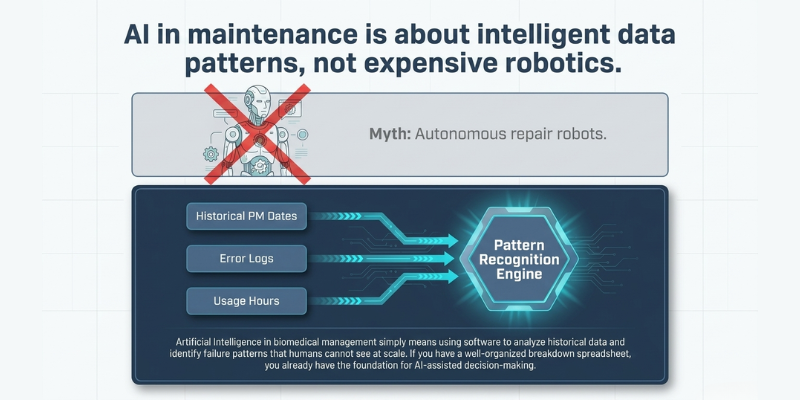
When I first encountered the term “AI in healthcare,” I thought it referred to robotic surgery or diagnostic imaging algorithms. It does — but in the context of biomedical equipment management, AI means something much more accessible: using software to analyze historical data and identify patterns that humans cannot see at scale.
In practical terms, AI for hospital equipment maintenance means feeding the following data into an analytical model:
- Equipment breakdown history (dates, fault descriptions, root causes)
- Preventive maintenance records (PPM dates, findings, components replaced)
- Spare parts replaced over time (frequency, component type)
- Error logs from equipment (where available via data port or service software)
- Usage hours and utilization data
- Vendor response time and repair duration
- Equipment age and installation date
- Warranty, AMC, or CMC status
Once equipment data is collected and cleaned, AI can analyze simple Excel trends or advanced Python-based machine learning models to predict which equipment is likely to fail, when it may fail, and the probable cause. This is the foundation of AI predictive maintenance in hospitals and helps biomedical teams reduce equipment downtime using AI.
Hospitals do not need deep knowledge of neural networks to begin. Even a well-structured breakdown spreadsheet can reveal useful failure patterns and support AI-assisted maintenance decisions.
How Hospitals Can Reduce Equipment Downtime: AI-Based Maintenance Strategy
This is the core of what most biomedical engineers need. Below are the practical AI methods your hospital can adopt, starting from the simplest approaches and progressing to more advanced implementations.
Predictive Maintenance
Predictive maintenance means servicing equipment when data shows it is needed, not only on a fixed schedule. AI models trained on hospital breakdown data can detect failure patterns early and help reduce equipment downtime using AI.
For example, if a ventilator model repeatedly develops flow sensor issues around 120 days after PPM, AI can flag the pattern and recommend early inspection before a breakdown occurs.
For a deeper practical example, you can also read my detailed case study on AI predictive maintenance in healthcare, where I explained how hospital breakdown data can be used to predict ventilator failure before it affects patient care.
Failure Pattern Detection
By analyzing breakdown records across equipment categories, AI identifies recurring failure modes. If your hospital’s 18 bedside monitors of a specific model all develop touch-screen failures after 18 months of use, this pattern becomes the basis for a targeted intervention — either a design modification, an early replacement plan, or a proactive repair programme.
Risk Scoring of Equipment
Not all equipment deserves equal attention. A risk score combines factors such as equipment age, breakdown frequency, criticality of clinical use, and availability of backup units to assign each piece of equipment a risk level (High / Medium / Low). ICU ventilators and dialysis machines in a single-unit department naturally score higher than a general-ward blood pressure monitor. This helps biomedical teams prioritize their limited time.
Automated PM Reminders and Scheduling
AI-powered CMMS (Computerized Maintenance Management Systems) can generate PM reminders automatically, track compliance in real time, and escalate overdue PPMs to department heads. Even a well-designed Excel template with conditional formatting and automated email alerts through Google Apps Script achieves a version of this for small hospitals.
Breakdown Trend Analysis
Monthly and quarterly breakdown trend reports — generated automatically from your data — allow management to see which equipment categories consume the most biomedical time and repair cost. This transforms biomedical departments from a reactive “fix-it” team into a proactive analytical unit.
Spare Part Forecasting
By analyzing the historical frequency of spare part replacement, AI can predict which components will be needed in the next quarter and at what quantity. This reduces emergency procurement delays significantly. A hospital managing 50 ventilators, for example, can predict annual consumption of flow sensors, exhalation valves, and battery packs with reasonable accuracy based on historical data.
Vendor Performance Tracking
AI dashboards can track vendor response time, first-fix rate, repeat call rate, and repair cost per vendor. This data supports contract negotiations and helps hospitals identify underperforming service vendors objectively rather than relying on anecdotal feedback.
Equipment Replacement Planning
Using age, breakdown frequency, total repair cost, and utilization data, AI models can generate evidence-based equipment replacement recommendations. This is extremely valuable when presenting CAPEX requests to hospital management, because it replaces subjective opinion with data-driven justification.
Real-Time Monitoring Using IoT Sensors
For hospitals with the infrastructure, IoT-enabled sensors attached to equipment can stream real-time operational data — temperature, voltage, vibration, power consumption — to a central dashboard. Anomalies trigger immediate alerts. While this requires investment, several medical equipment manufacturers now offer IoT connectivity as standard on newer models of CT scanners, MRI systems, and advanced ventilators. [3]
Practical Checklist: AI-Based Maintenance Actions for Biomedical Teams
- Digitize all breakdown records into a structured spreadsheet or CMMS
- Record fault description, root cause, downtime duration, and cost for every breakdown
- Calculate Mean Time Between Failures (MTBF) for high-risk equipment categories monthly
- Generate a risk score for each equipment asset quarterly
- Use historical spare part data to forecast quarterly procurement needs
- Track and report vendor response time for every service call
- Present breakdown trend analysis in monthly biomedical department reviews
- Identify top five high-risk equipment by category every quarter
Real-World Hospital Example: 25 Ventilators in the ICU

Let me give you a scenario that is very close to situations I have managed personally. A hospital has 25 ventilators deployed across its medical ICU, surgical ICU, and coronary care unit. Over the past 18 months, the biomedical team has responded to 68 ventilator breakdown calls. The breakdowns feel random — and without data analysis, they appear to be.
When we load the 18-month breakdown log into a structured spreadsheet and apply even basic AI analysis (using Python’s Pandas library or simply pivot tables in Excel), the following patterns emerge:
- Battery failures: 12 of the 25 ventilators are between 5 and 7 years old. Battery failures are concentrated almost entirely in this age group, occurring approximately every 8 months.
- Flow sensor errors: 6 ventilators of a specific model show flow sensor calibration drift consistently 4–5 months after their scheduled PPM. The PPM interval for this model may need to be shortened.
- Exhalation valve blockage: 3 ventilators used primarily in the surgical ICU (where secretion-heavy patients are common) show repeated exhalation valve issues. Cleaning protocol compliance data from user departments reveals that post-use cleaning is frequently incomplete.
- High repeat breakdown rate: 4 ventilators account for 29 of the 68 total calls (42%) despite representing only 16% of the fleet. These machines have breakdown frequency 3.5x the fleet average.
With this data, an AI-based system can now:
- Flag the 12 aging ventilators as High Risk and recommend preemptive battery replacement before the next ICU peak season.
- Recommend reducing the PPM interval for the 6 flow-sensor-prone models from quarterly to every 10 weeks.
- Trigger a user training session in the surgical ICU on post-use cleaning procedures.
- Recommend the 4 highest-failure ventilators for engineering review and potential replacement inclusion in the next CAPEX request.
Without structured data analysis, the biomedical engineer was reacting to each call individually. With AI, the team is now predicting failures, addressing root causes, and making evidence-based CAPEX recommendations — all from data they already had.
AI vs. Traditional Preventive Maintenance: A Comparison
Understanding the difference between traditional and AI-based maintenance helps biomedical managers make the case for change to hospital leadership.
| Comparison Area | Traditional Maintenance | AI-Based Maintenance |
|---|---|---|
| Maintenance Timing | Fixed calendar schedule (e.g., quarterly PPM regardless of equipment condition) | Condition-based; triggered when data indicates risk, not by calendar alone |
| Data Usage | Minimal; paper registers or basic logs rarely reviewed systematically | Historical breakdown data, PPM records, error logs, and usage hours analyzed continuously |
| Failure Prediction | Reactive; failure is detected after it occurs | Proactive; AI identifies failure probability before breakdown occurs |
| Cost Control | Emergency repair costs are unplanned and often high | Planned interventions reduce emergency repair costs; spare parts are pre-stocked |
| Spare Part Planning | Reactive procurement; delays extend downtime | AI forecasts spare part demand quarterly based on historical replacement patterns |
| Emergency Breakdowns | High frequency; consumes significant biomedical team time | Reduced frequency; high-risk equipment is addressed before failure |
| Decision-Making | Based on technician experience and intuition | Data-driven; trends and risk scores guide decisions with evidence |
| Biomedical Workload | Reactive, crisis-driven; difficult to plan staffing | Predictable, planned; team focuses on high-priority tasks based on risk data |
Data Required to Build an AI Downtime Reduction System
This is where many hospitals hesitate. They assume AI requires large, complex databases. In reality, a well-structured breakdown register — even in Excel — contains most of what you need. The fields below should be captured for every breakdown and PPM event:
| Data Field | Why It Matters |
|---|---|
| Equipment Name | Identifies the asset type for trend analysis |
| Make and Model | Enables model-specific failure pattern detection |
| Serial Number | Unique identifier for per-unit history tracking |
| Installation Date | Calculates equipment age; key for replacement planning |
| Department / Location | Links failures to usage environment and intensity |
| Breakdown Date and Time | Enables time-series analysis and MTBF calculation |
| Fault Description | Categorical classification of failure mode |
| Root Cause | Enables root cause trend analysis; supports process improvement |
| Spare Part Replaced | Drives spare part consumption forecasting |
| Downtime Duration (hours) | Quantifies patient care impact; used in cost calculations |
| Last PPM Date | Shows if failure occurred close to or far from last maintenance |
| Usage Intensity | High / Medium / Low; links utilization to failure rate |
| Vendor Response Time (hours) | Measures vendor accountability; drives contract discussions |
| Total Repair Cost | Enables total cost of ownership and replacement analysis |
| Warranty / AMC / CMC Status | Determines repair cost responsibility; flags out-of-coverage assets |
Pro Tip from the Field
Start by collecting just the top 8 fields consistently for every breakdown. Perfect data with 8 fields is far more valuable than incomplete data with 15 fields. Once the team builds the habit, add more columns gradually.
Step-by-Step Implementation Plan for Hospitals
Here is a practical roadmap that any hospital — large or small — can follow to implement AI-driven downtime reduction without a large upfront investment.
- 1Start With Excel or Google SheetsCreate a structured breakdown register with all the data fields listed in the previous section. Use Google Sheets for cloud access — it allows multiple team members to update records simultaneously and from any location.
- 2Clean Historical Breakdown DataCompile at least 12 months of past breakdown records. Standardize terminology — use consistent names for fault descriptions and equipment categories. Remove duplicates. This is the most time-consuming step but the most important.
- 3Identify High-Risk Equipment CategoriesUse pivot tables to calculate total breakdowns, average downtime, and average repair cost by equipment category. Equipment with high breakdown frequency AND high clinical criticality becomes your priority list.
- 4Create Failure IndicatorsFor your top 5 high-risk equipment categories, define specific indicators: breakdown frequency per quarter, MTBF, repeat fault percentage, and PM compliance rate. These become your early warning signals.
- 5Use AI Tools for Pattern AnalysisFor teams without programming experience, tools like ChatGPT, Claude, or Google Gemini can analyze your structured data when pasted into the chat. Ask it to identify breakdown patterns, calculate MTBF, or generate a risk ranking. For teams with basic Python knowledge, Pandas and scikit-learn provide more powerful predictive models. [4]
- 6Generate Monthly Risk ReportsProduce a one-page monthly risk report showing: top 5 high-risk equipment, breakdown trend vs. last quarter, PM compliance percentage, and key recommended actions. Share with the hospital engineering head and relevant clinical departments.
- 7Connect AI Findings With PM PlanningUse your breakdown data analysis to adjust PPM schedules. If a specific equipment model consistently fails 3 months after PPM, reduce the interval. If another model rarely fails and has excellent uptime, consider extending its PPM interval to free up biomedical staff time.
- 8Review Results With ManagementQuarterly, present the impact of your AI-based programme: How many breakdowns were prevented? How much downtime was reduced? What did that save in emergency repair costs? This evidence builds departmental credibility and supports budget requests.
Benefits of Using AI to Reduce Equipment Downtime
The business case for AI-based equipment maintenance in hospitals is strong. Here are the benefits that biomedical engineers and hospital administrators should communicate to leadership:
Better Patient Safety
Equipment that is monitored and maintained predictively is far less likely to fail during a critical clinical procedure. Fewer unplanned breakdowns mean fewer disruptions to patient care, fewer emergency transfers, and fewer adverse events related to equipment failure.
Reduced Emergency Breakdowns
This is the most direct and measurable benefit. Hospitals that implement structured breakdown analysis and AI-assisted predictive maintenance consistently report a reduction in unplanned equipment failures over 12–18 months. [5]
Lower Repair and Maintenance Costs
Planned component replacement during scheduled maintenance costs significantly less than emergency repair — in parts, labour, and vendor call-out fees. Predictive maintenance allows hospitals to replace components before they cause a full system failure.
Better Spare Part Planning
AI-forecasted spare part consumption reduces emergency procurement, which eliminates expensive expedited shipping costs and extended downtime waiting for parts.
Improved Equipment Availability
When equipment fails less often and is repaired faster when it does fail, overall equipment uptime increases. This directly improves the hospital’s capacity to serve patients without diverting resources.
Better NABH and Compliance Documentation
NABH accreditation standards require documented preventive maintenance, breakdown records, and equipment performance data. AI-organized records make this documentation audit-ready at all times, reducing the stress of inspection periods.
Better Vendor Accountability
Objective data on vendor response time, first-fix rate, and repeat call rate gives hospital management a factual basis for contract negotiations and vendor performance reviews.
Data-Driven CAPEX Planning
Perhaps the most underappreciated benefit: AI analysis gives biomedical engineers the data they need to make a compelling, evidence-based case for equipment replacement budgets. Instead of “this ventilator is old and needs replacing,” you can say “this ventilator has had 14 breakdowns in 12 months, with a total repair cost of $8,400 and an average downtime of 11 hours per incident — replacement will recover that cost within 18 months.”
Challenges Hospitals May Face
Honesty matters here. AI-based maintenance is not a plug-and-play solution. These are real challenges that hospitals will encounter, based on my experience helping departments implement data-driven maintenance programmes.
Poor Data Quality
The most common and most serious challenge. If breakdown records are incomplete, inconsistent, or missing entirely, AI has nothing reliable to work with. “Garbage in, garbage out” applies absolutely. A data quality initiative must come before any AI tool implementation.
Lack of Digital Records
Many hospital biomedical departments still operate entirely on paper. Converting historic paper records to digital is time-consuming but essential. Start with the past 12 months and move backward as capacity allows.
Resistance From Staff
Some experienced biomedical technicians and engineers may see structured data entry as additional administrative burden. The key is demonstrating quickly that the data helps them — by generating reports that support their decisions and reduce the number of emergency calls they respond to.
Lack of IT Support
Smaller hospitals may not have dedicated IT staff to support data systems or CMMS integration. This is why starting with Google Sheets or Excel is the recommended first step — these tools require no IT infrastructure.
Integration Issues With HIS or CMMS
Connecting AI tools to existing Hospital Information Systems or CMMS platforms requires technical expertise and often vendor cooperation. This is typically a second-phase activity after the foundational data structure is established.
Initial Learning Curve
Biomedical engineers are typically trained in electronics and clinical engineering, not data science. Learning to work with structured data, pivot tables, and basic AI tools requires time and willingness to develop new skills.
Need for Validation Before Critical Decisions
AI outputs are recommendations, not commands. Before acting on a predictive maintenance alert for a critical device like an ICU ventilator or dialysis machine, the biomedical engineer must assess the recommendation against their clinical engineering knowledge and equipment manufacturer guidelines. AI supports decision-making; it does not replace professional judgment.
Practical Solution for Small and Medium Hospitals
One of the most common questions I receive from biomedical engineers in smaller hospitals is: “Can we really use AI? We don’t have the budget for expensive software.”
The answer is yes — and here is the practical path:
- Phase 1 (No Cost): Excel or Google Sheets. Create a structured breakdown register. Use pivot tables for monthly trend analysis. Set up conditional formatting to flag high-frequency failure assets. Calculate MTBF manually for top equipment categories.
- Phase 2 (Low Cost): AI Chat Tools. Paste your structured data into ChatGPT, Claude, or Google Gemini. Ask it to identify patterns, generate risk scores, or write a breakdown trend summary. These tools are highly effective for pattern recognition in structured tabular data and are available for a few dollars per month or even free.
- Phase 3 (Intermediate): Python with Pandas and Matplotlib. For biomedical engineers willing to learn basic programming, Python can automate your analysis, generate monthly reports, and build simple predictive models. Dozens of free tutorials are available online specifically for maintenance data analysis. [6]
- Phase 4 (Scaled): CMMS Integration. Once the data discipline and analysis routine are established, moving to a dedicated CMMS platform with built-in analytics becomes a justified investment. Many CMMS platforms now include AI modules at reasonable subscription costs.
Important: Small hospitals should not attempt to jump directly to Phase 4. Building data discipline and team capability through Phases 1 and 2 is essential preparation. A hospital that cannot consistently fill in a breakdown record correctly will not get value from an expensive AI platform.
Role of Biomedical Engineers in AI-Based Downtime Reduction

Let me be very direct about something: AI will not replace biomedical engineers. What AI will do is make biomedical engineers significantly more capable, more credible, and more valuable to their hospitals.
Here is how biomedical engineers can position themselves as AI-enabled professionals:
Maintain High-Quality Data
The biomedical engineer who ensures that every breakdown record is complete, consistent, and categorized correctly is laying the foundation for everything else. Data quality is a professional responsibility, not just an administrative task.
Analyze Breakdown Patterns
Monthly pattern analysis — reviewing which equipment failed, how often, and why — should be a standard part of the biomedical department’s routine. This is not optional; it is the core of professional equipment management.
Coordinate With Vendors Using Data
Bring data to every vendor meeting. Vendor response time reports, repeat fault rates, and component failure frequency data change the dynamic of vendor relationships from passive to accountable.
Train Clinical Users
When data reveals that user handling is contributing to equipment failures, the biomedical engineer should design and deliver targeted training. This is a clinical contribution, not just a technical one.
Improve PM Schedules Based on Evidence
Use breakdown data to refine PPM frequencies for specific equipment models. This is AI-supported clinical engineering at its most practical.
Present Insights to Management
One of the highest-value activities for a senior biomedical engineer is translating data into management-ready insights: risk reports, cost-benefit analyses for equipment replacement, and CAPEX justifications backed by breakdown statistics.
Lead Hospital Innovation
Biomedical engineers who master AI-assisted maintenance become the bridge between clinical technology and hospital strategy. This is a career-defining evolution of the profession.
Key Performance Indicators to Track
To measure the effectiveness of your AI-based maintenance programme, you need a defined set of KPIs. Here are the most important ones, with practical explanations:
| KPI | Meaning | Why It Matters |
|---|---|---|
| Equipment Uptime % | Percentage of time equipment is available and functional | The primary measure of maintenance programme effectiveness; target is typically 95%+ for critical equipment |
| Mean Time Between Failures (MTBF) | Average time between two consecutive breakdowns for a specific asset | Rising MTBF indicates improving equipment reliability; declining MTBF signals increasing risk |
| Mean Time To Repair (MTTR) | Average time to restore equipment from breakdown to operational status | Reflects repair efficiency and spare part availability; lower MTTR reduces patient care disruption |
| Repeat Breakdown Rate | Percentage of breakdowns that recur for the same fault on the same asset within 30 days | High repeat rates indicate repair quality issues or underlying unresolved faults |
| PM Compliance % | Percentage of planned PPMs completed on schedule in a given period | The leading indicator of maintenance programme discipline; low compliance predicts rising breakdowns |
| Average Vendor Response Time | Average hours from service call to vendor engineer on-site | Drives accountability in AMC/CMC contracts; directly impacts downtime duration |
| Spare Part Delay Rate | Percentage of breakdowns where downtime was extended due to unavailable spare parts | Highlights inventory management gaps; drives spare part forecasting improvements |
| Downtime Cost (per equipment / per quarter) | Financial cost of equipment downtime including lost revenue and emergency repair | Translates maintenance performance into financial language for management decision-making |
| High-Risk Equipment Count | Number of assets currently classified as High Risk based on AI risk scoring | A leading indicator; hospitals should target a declining count over time as interventions are implemented |
The Future of AI in Biomedical Equipment Management

The next five years will bring significant advances in how hospitals manage medical equipment. Based on current trends in healthcare technology and biomedical engineering, here is what is coming:
IoT-Enabled Equipment Monitoring
More equipment manufacturers are embedding IoT connectivity into their devices as standard. Ventilators, infusion systems, and even dialysis machines will stream real-time operational data to central hospital monitoring platforms. This will shift AI maintenance from retrospective pattern analysis to live anomaly detection. [7]
CMMS Integration With AI Analytics
Modern CMMS platforms are beginning to integrate machine learning models that automatically score equipment risk, generate PM schedules, and predict spare part demand. As these platforms become more affordable, they will become standard for hospitals of all sizes.
AI-Based Service Ticketing
Future systems will automatically generate, categorize, and prioritize service tickets based on equipment risk score and clinical impact — removing the manual workload of ticket management from biomedical teams.
Digital Twins for Medical Equipment
A digital twin is a virtual replica of a physical equipment asset that mirrors its real-time operational state. For complex equipment like CT scanners and MRI systems, digital twins allow engineers to simulate failure scenarios, test maintenance interventions, and predict component lifespans without touching the actual machine. Several major medical equipment manufacturers are already developing this capability. [8]
Automatic Risk Scoring and Alerts
Hospital-wide dashboards that display real-time equipment risk scores for every asset in the inventory — colour-coded by risk level and department — are beginning to appear in well-resourced hospitals. This gives biomedical managers an instant view of where attention is needed across a large and complex equipment fleet.
Predictive Spare Part Management
AI systems will link equipment failure predictions directly to automated procurement workflows, ordering spare parts in advance of predicted failures and alerting biomedical teams when stock falls below a safety threshold for critical components.
Frequently Asked Questions
1. Can AI really reduce hospital equipment downtime?
Yes — but with an important qualification. AI does not reduce downtime by itself. It reduces downtime by giving biomedical engineers better information to act on. When AI identifies a pattern of battery failures in older ventilators, it is the biomedical engineer who acts on that finding by scheduling preemptive replacements. The combination of AI analysis and professional action is what reduces downtime. Studies in industrial maintenance and healthcare engineering consistently show that predictive maintenance approaches reduce unplanned downtime compared to purely calendar-based programmes.
2. Do hospitals need expensive software to start?
No. The most important starting point is structured data collection, and this requires only Excel or Google Sheets. Once a hospital has 12 months of well-organized breakdown data, free and low-cost AI tools — including generative AI assistants like ChatGPT, Claude, or Gemini — can provide meaningful pattern analysis. Expensive CMMS platforms with AI modules are a second or third phase, not a starting requirement.
3. Which equipment should be monitored first?
Prioritize equipment based on two criteria: clinical criticality and breakdown frequency. ICU ventilators, dialysis machines, anesthesia machines, and patient monitors in high-dependency areas should always be in the highest priority tier. Within that group, focus your first analytical effort on equipment with the highest breakdown frequency or highest total repair cost over the past 12 months. This combination of clinical risk and maintenance cost gives you the highest return on your analytical effort.
4. Can small hospitals use AI for equipment maintenance?
Absolutely. In some ways, the challenge is simpler for smaller hospitals because the equipment fleet is smaller and the data volume is more manageable. A district hospital with 200 medical devices can implement AI-assisted maintenance using Google Sheets and free AI tools within 30 days of deciding to start. The key is discipline in data entry, not software sophistication.
5. What data is required for AI predictive maintenance?
The minimum viable dataset includes: equipment name, model, serial number, installation date, department, breakdown date, fault description, root cause, spare part replaced, downtime duration, last PPM date, and repair cost. Twelve months of consistently recorded data in these fields is enough to begin meaningful AI-assisted analysis. More data fields and longer historical records improve prediction accuracy, but the basics above are sufficient to start.
6. Is AI replacing biomedical engineers?
No. AI cannot physically inspect a ventilator, perform calibration, interpret an unusual error code in a clinical context, or make a judgment call about whether a repaired device is safe to return to patient use. These require a qualified biomedical engineer. What AI does is handle the data analysis workload that previously required hours of manual review — freeing engineers to focus on technical problem-solving and clinical collaboration. The biomedical engineers who will thrive in the next decade are those who combine their technical expertise with data literacy and AI proficiency.
Conclusion: The AI-Enabled Biomedical Department
Medical equipment downtime is not an inevitable cost of hospital operations. It is, to a significant degree, a predictable and preventable problem — if hospitals are willing to collect the right data and use modern analytical tools to act on it.
The ability to reduce equipment downtime AI-based approaches offer is real and accessible, even for hospitals that cannot invest in expensive platforms today. Starting with structured data in a spreadsheet, applying pattern analysis using AI chat tools, and building a culture of evidence-based equipment management is achievable by any biomedical team that commits to it.
The roadmap is clear: collect data, clean it, analyze it, act on it, and measure the results. Repeat monthly. Share the findings with management. Use the evidence to improve PM schedules, strengthen vendor contracts, plan spare parts intelligently, and make CAPEX requests that decision-makers can support with confidence.
And for my fellow biomedical engineers reading this: AI will not replace you. But the biomedical engineer who uses AI will be more effective, more credible, and more indispensable to their hospital than the one who does not. The choice is yours, and the tools to start are available right now.
Disclaimer: This article is intended for educational and informational purposes only. The AI-based maintenance strategies, tools, and recommendations described in this article are general guidance based on professional experience and publicly available information. AI-based maintenance decisions should be validated by qualified biomedical engineers, equipment manufacturers, and applicable hospital policies before implementation. Clinical engineering decisions must always comply with local regulatory requirements, equipment manufacturer service guidelines, and patient safety standards. The author and MedTech Insighter assume no liability for specific implementation decisions made by individuals or institutions based on this content.
1 thought on “How Hospitals Can Reduce Equipment Downtime Using AI: A Practical Guide for Biomedical Teams”