A decade ago, when hospitals were evaluating a linear accelerator, the central question was precision: how tightly can this machine shape and aim the beam? In 2026, that question is largely settled. Modern LINACs are all extraordinarily accurate. The question that now separates one system from another — and the one I find myself asking in every CAPEX discussion — is a different one entirely: how intelligently can the machine adapt the plan to the patient in front of us, today?
That shift, from static delivery to real-time intelligence, is the single biggest story in radiotherapy technology right now. This is a practitioner’s guide to the latest LINAC technology in 2026 — what has actually changed, how the major vendors compare, and what it all means for a hospital that has to buy, run and justify one of these systems.
Table of Contents
From precision to intelligence: what actually changed
The last generation of advances — IMRT, VMAT, image-guided radiotherapy (IGRT) — solved the problem of accuracy. We can now paint a dose distribution around a tumour with remarkable conformity and spare the healthy tissue around it. That is no longer the frontier.
The frontier is adaptation. A radiotherapy plan is typically built from a CT scan taken days or weeks before treatment starts. But over a course of 20–35 fractions, the patient changes: the tumour shrinks, the patient loses weight, the bladder and bowel fill and empty differently each day, and organs shift. A plan that was perfect at simulation is quietly no longer perfect by the third week. Adaptive radiotherapy is the response to that reality — and in 2026, it is being driven by artificial intelligence.
AI-driven online adaptive radiotherapy: the headline trend
Online adaptive radiotherapy (ART) is the defining capability of the current LINAC generation. The workflow, stripped to its essence, is this: the patient is imaged on the treatment couch at the start of each session; AI automatically re-contours the anatomy from that image; the treatment plan is re-optimised to match the patient’s anatomy that day; and the adapted plan is delivered — all within the treatment slot, while the patient waits on the table.
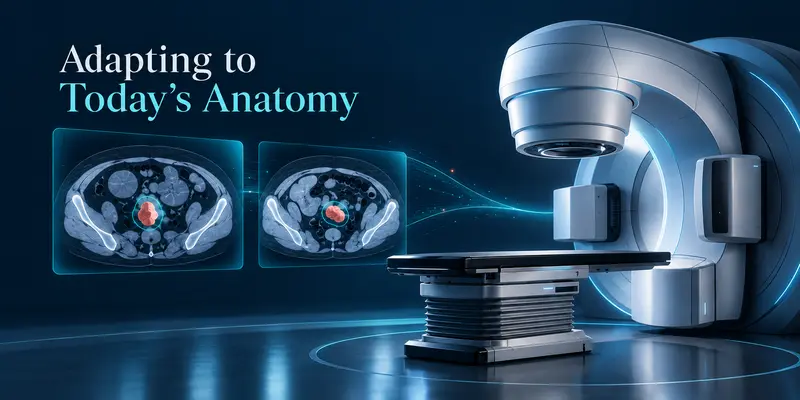
Clinically, this means tighter margins, less dose to healthy tissue, and better sparing of critical organs. It is a genuine step change, not a marketing one.
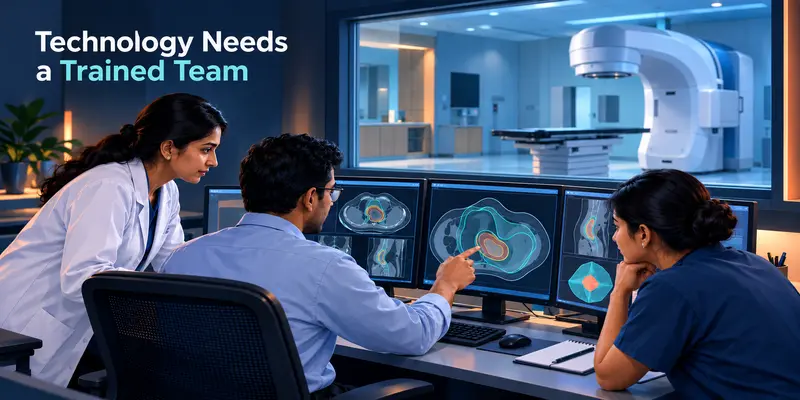
But here is the part the glossy brochures skip, and the part that matters most from the biomedical and operational seat: adaptive radiotherapy is not free. It demands longer treatment slots, significantly more physics and dosimetry workload, more quality assurance, and a trained workforce that can actually run the adaptive process reliably, day in and day out. The technology scales the expertise of your team — it does not replace it. A hospital that buys adaptive capability it cannot staff has bought a very expensive conventional linac.
The three-way race: Ethos vs Evo vs uRT-linac 506c
For years the high-end linac market was effectively a two-vendor contest. In 2026 it is a three-way race — and all three leading platforms are now competing specifically on AI-driven adaptive radiotherapy.
| System | Vendor | Adaptive approach | Distinctive angle |
| Ethos | Varian (Siemens Healthineers) | AI online ART within a standard slot; HyperSight CBCT imaging | The established adaptive flagship |
| Evo | Elekta | AI-powered adaptive CT-linac | Brings online ART to a conventional-style linac |
| uRT-linac 506c | United Imaging | Integrated diagnostic CT + linac; uCT-ART workflow | All-in-One single-room integration; cost-competitive entrant |
Varian Ethos (Siemens Healthineers)
Ethos is the established adaptive flagship and the system most clinicians think of first when they hear “online adaptive.” Its AI re-planning runs within a standard treatment slot, and it is paired with HyperSight — an iterative cone-beam CT that produces near-diagnostic-quality images in seconds, which is what makes fast, reliable adaptation practical. Varian has continued to extend the platform, and HyperSight imaging is now reaching the widely installed TrueBeam line as well, including in the Asia-Pacific market.
Elekta Evo
Evo is Elekta’s AI-powered, adaptive CT-linac — their answer to the online-ART challenge, bringing adaptive capability to a conventional-style linac platform rather than requiring a fundamentally different machine. For hospitals that want to step into adaptive therapy without the cost and complexity of an MR-Linac, it is a significant option, and Elekta has been actively introducing it to the Indian market.
United Imaging uRT-linac 506c
This is the entrant that changes the shape of the market, and the one too often left out of Western comparisons. The uRT-linac 506c takes a different architectural approach: instead of a cone-beam CT bolted onto the linac, it integrates a diagnostic-quality CT scanner coaxially with the accelerator on a shared table — an “All-in-One” design covering simulation through delivery in one room. United Imaging reports an online adaptive workflow (uCT-ART) averaging around 15 minutes and a “native AI” architecture linking imaging, contouring, planning, QA and delivery in a closed loop, with auto-contouring time reductions of up to 90%. The system is CE-marked (noted as not available for sale in all markets). As with any vendor, those performance figures are the manufacturer’s own — but the architecture is genuinely distinctive, and as a cost-competitive challenger it is reshaping procurement decisions, particularly across Asian markets.
A note on accuracy: vendor model names, “latest” claims and performance numbers move quickly in this field. Verify the current flagship and specifications on each manufacturer’s own documentation before making any purchase decision.
Beyond adaptive: the surrounding technology fronts
MR-Linac (MR-guided radiotherapy)
An MR-Linac fuses a linear accelerator with a real-time MRI scanner, giving live soft-tissue imaging during delivery — something CT-based guidance cannot match. Elekta’s Unity delivers 1.5T MR imaging during treatment. The sweet spot is tumours that move or sit against critical soft-tissue organs — pancreas, liver, prostate — where seeing the actual target in real time changes what is safely possible. The trade-off is cost and complexity, though in many markets MR-guided treatment earns higher reimbursement that helps offset it.
Surface-Guided Radiotherapy (SGRT)
SGRT uses optical cameras to track the patient’s skin surface in three dimensions, enabling sub-millimetre positioning and continuous motion monitoring — without tattoos, and with safer breath-hold techniques. Its best-known benefit is in left-sided breast treatment, where breath-hold combined with surface tracking helps move dose away from the heart.
Advanced imaging and faster delivery
Iterative cone-beam CT such as HyperSight is raising on-couch image quality to near-diagnostic levels, which is precisely what makes adaptive workflows dependable. Alongside it, single-arc VMAT and high-dose-rate flattening-filter-free (FFF) beams keep compressing treatment times, which matters as much for department throughput as for the individual patient.
FLASH radiotherapy: the real frontier
FLASH is the most exciting idea on the horizon — and the one most often overstated. By delivering the entire dose in under a second at ultra-high dose rates, FLASH appears to spare healthy tissue while still destroying the tumour, a phenomenon known as the “FLASH effect.” It is genuinely promising. But it is important to be honest about where it stands: FLASH remains largely preclinical and in early clinical trials. It is a frontier technology to watch, not a capability you can buy and treat with routinely today.
The buyer’s reality: what this means for Indian hospitals
Choosing the latest LINAC technology is not only a clinical decision — it is a capital and operational one, and it is the one that matters most if you are the person who has to recommend, justify and live with the purchase. From the biomedical and CAPEX seat, the technology is only half the decision.
- Match adaptive capability to case mix and workforce. Adaptive radiotherapy is transformative for the right cases — but if your case mix or staffing will not keep an adaptive workflow genuinely utilised, you are paying a premium for a feature that sits idle. Buy for the patients you actually treat.
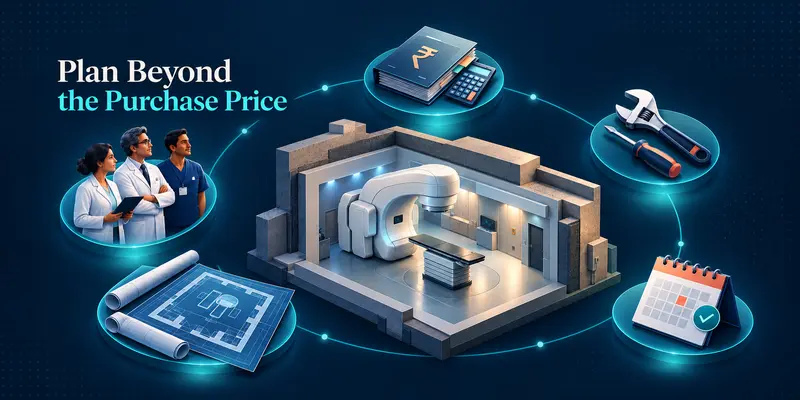
- Think total cost of ownership, not sticker price. The accelerator is the beginning. Bunker and civil works, shielding, service contracts, the physics and radiotherapy workforce, uptime and spare-part logistics — these determine the real cost and the real clinical availability over the machine’s life.
- AERB licensing and bunker compliance are procurement gates, not afterthoughts. In India, radiation-facility layout, shielding and AERB approvals are part of the critical path. Factoring them in early is the difference between a smooth commissioning and an expensive delay.
- Cost-competitive entrants are changing the equation. The arrival of strong challengers like United Imaging is widening the field and putting real pressure on pricing — good news for hospitals, provided the evaluation stays honest about workforce, service and long-term support, not just capital cost.
If you’re planning a new radiotherapy or oncology service, this technology choice sits inside a much larger setup decision — something I cover in my guide to starting an oncology centre.
Frequently Asked Questions
What is adaptive radiotherapy?
Adaptive radiotherapy adjusts a patient’s treatment plan to account for anatomical changes over a course of treatment. In online adaptive radiotherapy, the patient is imaged on the treatment couch, AI re-contours the anatomy, and the plan is re-optimised to the patient’s anatomy that day — all within the treatment session.
What is the difference between a CT-linac and an MR-Linac?
A CT-linac uses X-ray (CT or cone-beam CT) imaging for guidance and adaptation; an MR-Linac integrates a real-time MRI scanner, giving superior soft-tissue imaging during treatment. MR-Linacs excel for moving or soft-tissue tumours but cost more; CT-linacs are more widely deployable and now offer strong AI adaptive capability of their own.
Is FLASH radiotherapy available yet?
Not for routine clinical use. FLASH radiotherapy — ultra-high-dose-rate treatment that may spare healthy tissue — is promising but remains largely preclinical and in early clinical trials as of 2026. It is a technology to watch, not yet a standard clinical option.
Which LINAC is best for a hospital in India?
There is no single best machine — the right choice depends on your case mix, budget, available physics and radiotherapy workforce, service support in your region, and AERB/bunker constraints. A high-end MR-Linac, an AI adaptive CT-linac, and a cost-competitive integrated system each suit different hospitals. The evaluation, not the brand, decides the outcome.
What is the difference between Varian Ethos, Elekta Evo and United Imaging uRT-linac?
All three offer AI-driven adaptive radiotherapy. Ethos is the established adaptive flagship with HyperSight imaging; Evo brings online adaptive therapy to a conventional-style CT-linac; and the uRT-linac 506c uses an integrated diagnostic-quality CT and linac in a single-room “All-in-One” design and competes strongly on cost.
Conclusion: where the latest LINAC technology is heading
The latest LINAC technology is quietly becoming something new — the linear accelerator is no longer just a delivery device. It is no longer just a precise delivery device — it is turning into a real-time decision system that sees the patient as they are today and adapts accordingly. For clinicians, that promise is extraordinary. For hospitals, the hard part has shifted: the challenge is no longer buying precision, which is now a given, but matching adaptive capability to case mix, workforce and budget — and running it well, every day, for a decade.
That gap, between what the technology can do and what a hospital can actually operationalise, is exactly where biomedical engineering earns its place. The machine is getting smarter. The job is making sure the department around it is ready to use it.
I advise hospitals on radiotherapy and high-value medical equipment — technology evaluation, CAPEX justification, and the operational reality of running these systems. If that is where your department is headed, get in touch at impbiomed.com.
Disclaimer: Vendor model names, specifications and availability change frequently, and figures attributed to manufacturers are as reported by them. This article is for general information from a biomedical engineering perspective; verify current models and regional regulatory status with the manufacturers and your local authorities before any purchase decision.