In every hospital, some equipment failures are an inconvenience and others are a crisis. A malfunctioning waiting-room display costs a few minutes of annoyance. A ventilator that fails in the ICU, or a Cath Lab that goes dark mid-procedure, is a patient-safety event. Yet most biomedical departments still manage these assets with the same maintenance calendar and the same urgency — as if a 700-asset inventory were one undifferentiated list.
It isn’t. And treating it that way is expensive, risky, and increasingly out of step with what accreditors expect.
This is where AI-driven medical equipment risk assessment changes the game. Instead of asking “what is scheduled for maintenance this month?”, it asks a far more useful question: “which assets, right now, carry the highest combined clinical, operational, financial and regulatory risk — and what should we do about them first?” That shift, from asset management to asset risk intelligence, is what this guide is about.
Table of Contents
Why All Equipment Should Not Be Treated Equally
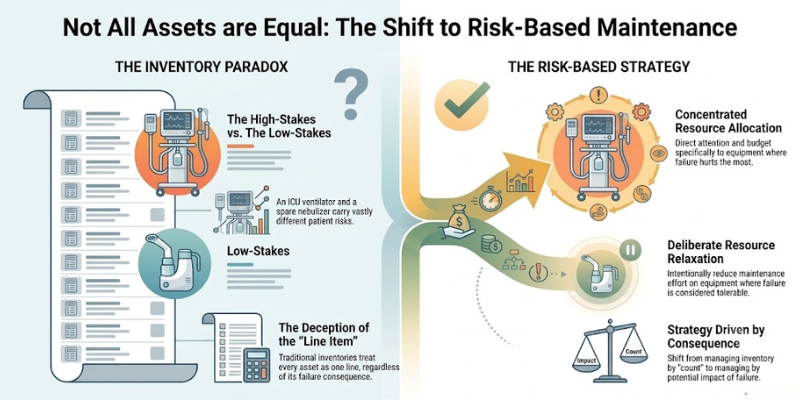
A modern hospital runs hundreds to thousands of biomedical assets, from infusion pumps to LINACs. Each one has a different consequence-of-failure profile. A single 24/7 ICU ventilator supporting a critical patient does not carry the same risk as a spare nebulizer in a store room, even if both appear as one line each in your inventory.
Risk-based prioritization accepts this reality. It concentrates attention, budget and preventive effort where failure would hurt the most — and deliberately relaxes it where failure is tolerable. The result is a maintenance and capital strategy driven by consequence, not by count.
Understanding Medical Equipment Asset Risk
Asset risk is not a single number pulled from thin air. It is a composite of four distinct dimensions that a biomedical department can actually measure.
Clinical risk captures the patient-safety consequence of failure. Life-support and therapeutic-delivery devices — ventilators, defibrillators, anaesthesia machines, dialysis units — sit at the top. If failure can directly harm or endanger a patient, clinical risk is high.
Operational risk captures how badly a failure disrupts service delivery. A single-unit CT scanner or a Cath Lab has no redundancy; downtime stops a whole service line, cancels procedures and creates patient backlogs. Equipment with backups or ready substitutes carries lower operational risk.
Financial risk captures the cost exposure of the asset — repair cost, downtime revenue loss, spare-part lead times and, for high-value CAPEX like MRI or LINAC, the sheer replacement burden. A failure that triggers a multi-lakh emergency repair or lost procedure revenue scores high.
Regulatory risk captures accreditation and compliance exposure. Equipment tied directly to NABH, JCI, AERB or MvPI obligations — and assets whose failure would surface in an audit or an adverse-event investigation — carry regulatory weight that pure engineering metrics miss.
An intelligent risk model combines these four into a single, defensible risk score per asset. That score is what lets a biomedical head walk into a management meeting and say, with evidence, “these are our twenty highest-risk assets, and here is why.”
Why Traditional Prioritization Falls Short
Most departments already prioritize — they just do it with blunt instruments.
Age-based planning assumes older equipment is riskier. Sometimes true, often not. A well-maintained ten-year-old analyzer can be more reliable than a poorly supported three-year-old import with no local spares. Age is a weak proxy for risk.
Cost-based planning prioritizes by purchase value. But an expensive asset that rarely fails and has redundancy may be far safer than a modest, single, heavily-used device with no backup. Price is not risk.
Fixed PM schedules apply the same preventive-maintenance frequency to broad equipment classes, usually straight from the manufacturer’s manual. This over-services low-risk assets (wasting technician hours) while under-serving a few high-consequence ones. It is effort spread evenly across a landscape that is anything but even. Moving to a risk-based preventive maintenance system is the first practical step away from this trap.
Each of these methods optimizes for one variable. Real risk is multi-variable — which is precisely why it needs a model.
The Data Hospitals Already Have
The best news for most biomedical teams: you do not need to buy new data to start. You are almost certainly sitting on it already.
A workable risk model can be built from the records a department generates every day — maintenance history (frequency and nature of breakdowns), failure history (mean time between failures, recurring faults), utilization data (how heavily each asset actually runs), vendor performance (response times, resolution times, AMC/CMC reliability), spare-parts inventory (availability and lead time), and clinical dependency (whether a device is single-point-of-failure for a service).
Individually these logs feel like paperwork. Combined, they are a rich signal of where risk truly concentrates. The barrier is rarely data availability — it is that the data lives in disconnected registers, PM sheets and vendor emails instead of one structured system. If you are formalizing this, the biomedical equipment management fundamentals and India’s national biomedical equipment management guidance are useful reference points for structuring the inventory.
The Regulatory Tailwind: Risk-Based Maintenance Is Already Expected
Risk-based equipment management is not a futuristic idea an accreditor might one day want. It is already embedded in the standards most Indian and international hospitals work under.
NABH’s accreditation standards expect a documented, risk-categorized inventory with maintenance planned according to criticality — not a flat schedule. Internationally, CMS and AAMI’s equipment-management standards formally support risk-based Alternative Equipment Maintenance (AEM) programs, which adjust maintenance strategy based on a documented risk assessment rather than defaulting to manufacturer schedules for every device. And for any hospital reporting device-related adverse events, the Materiovigilance Programme of India (MvPI) makes the link between equipment risk and patient-safety surveillance explicit. The long-standing AAMI risk-scoring approaches to equipment classification are the conceptual ancestor of exactly what AI now makes scalable.
In other words: assessors already want you to prioritize by risk. An AI-driven model does not invent a new obligation — it gives you a rigorous, auditable, defensible way to satisfy an existing one. For any hospital on the NABH or JCI path, that alignment is a strong reason to move first.
Building an AI Asset Risk Model
Here is the part that intimidates teams unnecessarily: you do not need a data-science department to begin. A credible risk model is a staircase, not a leap.
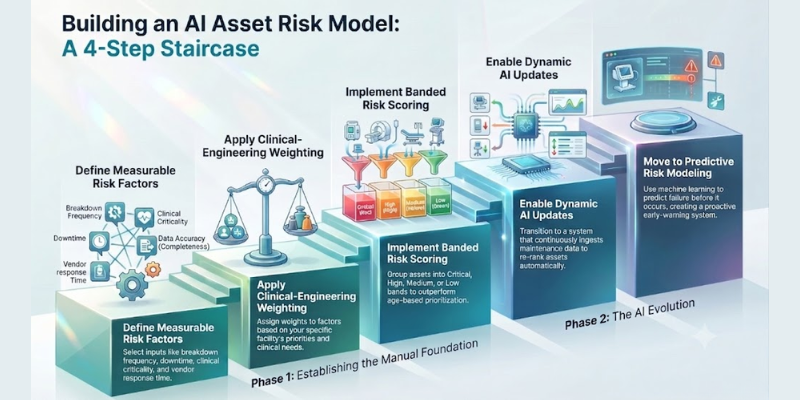
Step one — risk factors. Select the measurable inputs from the data above: breakdown frequency, downtime hours, MTBF, utilization, spare-part lead time, vendor response time, clinical criticality, and regulatory tie-in.
Step two — weighting methodology. Assign each factor a weight reflecting its importance to your hospital. A tertiary-care ICU-heavy facility may weight clinical criticality highest; a diagnostics-led centre may weight operational continuity. Weighting is a clinical-engineering judgment, and documenting it is exactly what makes the model defensible in an audit.
Step three — risk scoring. Combine weighted factors into a single score per asset and band them (for example, Critical / High / Medium / Low). At this stage a well-built weighted model — even in a spreadsheet or a lightweight app — already outperforms age- or cost-based prioritization.
Step four — dynamic updates. This is where AI earns its place. Instead of a static annual score, the model ingests fresh maintenance and failure data continuously and re-ranks assets automatically. Machine-learning methods can go further and predict elevated failure risk before it happens, turning the register from a rear-view mirror into an early-warning system.
The practical path is: start with transparent weighted scoring to earn trust and prove value, then layer predictive machine learning where the data supports it.
A Practitioner’s Proof: From Ventilator Failures to Prediction
This is not theory for me. In our biomedical department, ventilator downtime was a recurring, high-consequence problem — the definition of a top-risk asset class. Rather than accept reactive firefighting, we deployed our AI ventilator failure prediction model (a Random Forest classifier) across our ventilator fleet, using operational parameters logged from the devices to flag units at elevated risk of failure before they went down.
The point of sharing this is not the algorithm — it is the principle. The ventilators earned that investment because a structured risk view identified them as the highest-consequence, highest-failure class in the inventory. AI didn’t replace biomedical judgment; it scaled it. Risk assessment tells you where to point predictive AI. That sequence — risk first, prediction second — is the whole strategy in miniature.
High-Risk Hospital Use Cases
Where does asset risk intelligence deliver the fastest return? These asset classes tend to surface at the top of most hospitals’ risk rankings.
ICU ventilators — Direct life support, high utilization, low failure tolerance. Failure is a patient-safety event. Almost always Critical risk, and an ideal candidate for predictive maintenance.
Cath Lab — Single service line, no redundancy, high procedure revenue, patient in-procedure exposure. Downtime is both a clinical and a significant financial event.
CT scanner — Frequently the only unit in a facility, feeding emergency, in-patient and out-patient diagnostics simultaneously. High operational and financial risk from any downtime.
MRI — Very high CAPEX, complex service dependencies, cryogen and helium considerations, long repair lead times. Failures are expensive and slow to resolve — high financial and operational risk.
Medical Gas Pipeline System (MGPS) — Infrastructure that supports many patients at once. Low failure frequency but catastrophic consequence and heavy regulatory scrutiny. Classic high-clinical, high-regulatory risk.
Laboratory analyzers — High throughput and diagnostic dependency; a failure can stall reporting across departments. Turnaround-time impact and clinical dependency drive the risk here.
Each of these carries a different mix of the four risk dimensions — which is exactly why a composite score beats any single-factor rule.
The Executive Dashboard: Turning Scores into Decisions
A risk model is only as useful as the decisions it drives. The output that gets management attention is a clean executive view, not a spreadsheet of raw scores.
An effective biomedical engineering impact dashboard surfaces the top 20 highest-risk assets at a glance, a department-level risk heatmap that shows leadership where risk concentrates across the hospital, a view of predicted operational impact (which failures would disrupt which services), and a maintenance priority ranking that tells technicians and planners what to address first and why.
This is what converts biomedical engineering from a cost centre into a strategic function. When a department head can show leadership a risk-ranked, evidence-backed picture of the entire asset base — and tie it to patient safety, uptime and CAPEX planning — the conversation about budget and headcount changes completely.
Implementation Roadmap
You can move from idea to working model in a structured, low-risk sequence.
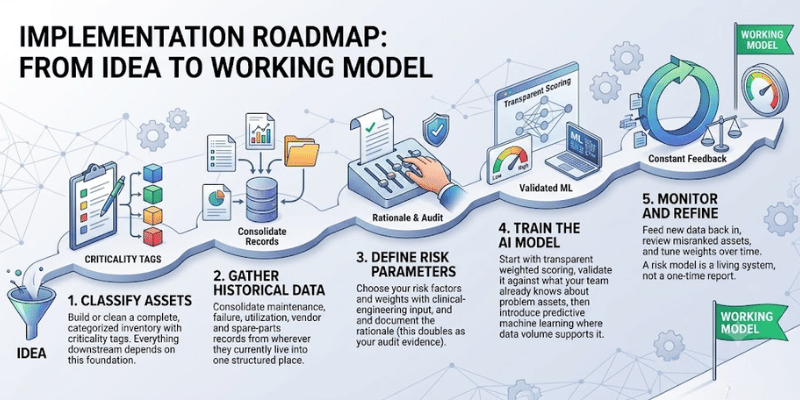
1. Classify assets — Build or clean a complete, categorized inventory with criticality tags. Everything downstream depends on this foundation.
2. Gather historical data — Consolidate maintenance, failure, utilization, vendor and spare-parts records from wherever they currently live into one structured place.
3. Define risk parameters — Choose your risk factors and weights with clinical-engineering input, and document the rationale (this doubles as your audit evidence).
4. Train the AI model — Start with transparent weighted scoring, validate it against what your team already knows about problem assets, then introduce predictive machine learning where data volume supports it.
5. Monitor and refine — Feed new data back in, review misranked assets, and tune weights over time. A risk model is a living system, not a one-time report.
What AI Can’t Do — and Why That Matters
Responsible adoption means being clear about the limits. AI does not replace biomedical judgment; it structures and scales it. A model is only as good as the data feeding it — incomplete or inconsistent logs produce unreliable scores. It cannot foresee every failure mode, particularly rare, first-of-their-kind faults with no historical signal. And it must never become a black box: for both clinical trust and accreditation, a hospital needs to explain why an asset was ranked where it was.
The right mental model is a co-pilot, not an autopilot. AI does the heavy, continuous, multi-variable ranking that no human can do by hand across hundreds of assets. The biomedical engineer stays in command of the decisions.
Frequently Asked Questions
What is medical equipment risk assessment?
Medical equipment risk assessment is the process of scoring each biomedical asset by the consequence and likelihood of its failure — combining clinical, operational, financial and regulatory factors — so a hospital can prioritize maintenance, monitoring and capital investment where risk is highest.
How does AI improve medical equipment prioritization?
AI continuously combines many risk factors across hundreds of assets, updates scores as new maintenance and failure data arrive, and can predict elevated failure risk in advance — something manual, single-factor methods like age- or cost-based planning cannot do reliably at scale.
Which medical equipment is considered highest risk?
Life-support and single-point-of-failure assets typically rank highest — ICU ventilators, Cath Labs, CT scanners, MRI systems, medical gas pipeline systems and high-throughput laboratory analyzers — because their failure carries severe clinical, operational or financial consequences.
Do hospitals need a data science team to start?
No. A transparent weighted risk-scoring model, built from existing maintenance and failure records, already outperforms traditional prioritization. Predictive machine learning can be added later once the basics are proven and data volume supports it.
Is risk-based maintenance accepted by NABH and JCI?
Yes. Risk-categorized inventories and risk-based maintenance are expected under NABH, and CMS and AAMI standards formally support Alternative Equipment Maintenance (AEM) programs that adjust maintenance strategy based on a documented risk assessment.
What data is needed to build an asset risk model?
Maintenance history, failure history, utilization, vendor performance, spare-parts availability and clinical dependency — records most biomedical departments already generate daily but keep in disconnected systems.
Conclusion: From Asset Management to Asset Risk Intelligence
Managing a large biomedical inventory as one flat list is a habit, not a strategy. The shift the best departments are making is from asset management — counting, scheduling, reacting — to asset risk intelligence: understanding, ranking and acting on the true consequence of failure across every device in the hospital.
AI is what makes that shift practical at scale. It turns the maintenance logs you already keep into a live, ranked, defensible picture of where risk lives — one that protects patients, reduces downtime, sharpens CAPEX decisions, and stands up in an NABH or JCI audit. The technology is ready. The data is already in your hospital. The only real question is which department moves from managing assets to managing risk first.
If you’d like help building a risk-based equipment model or bringing predictive AI into your biomedical department, get in touch — this is the exact work I do with hospitals as a practicing biomedical engineering head. You can also start with my Article, Top AI Tools for Biomedical Engineers (2026 Guide).