| By Senior Biomedical Strategist | Updated: March 18, 2026 | 15 Min Read |
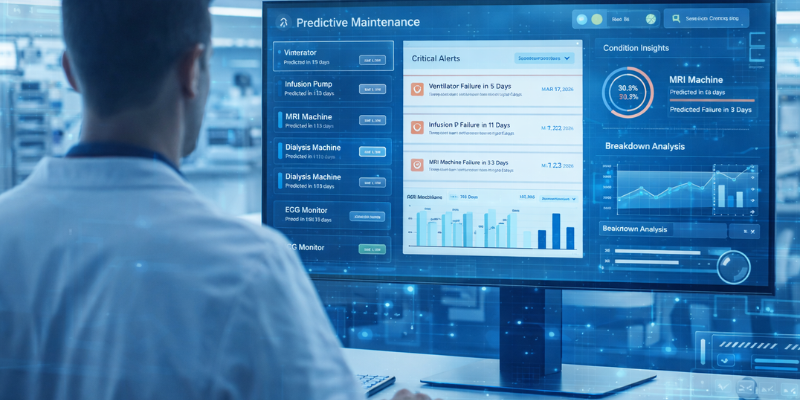
It’s 3:00 AM in a high-acuity ICU. A critical ventilator begins throwing a cryptic “Error 402,” and the night shift nurse is frantic. In 2024, you’d be driving to the hospital, hoping the spare parts are in stock. But today, on March 18, 2026, your dashboard already flagged this unit three days ago. Thanks to modern AI tools for biomedical engineers, the parts were ordered automatically, and the repair was scheduled for a low-census window tomorrow. The “Error 402” didn’t even happen because you intervened early.
As a senior biomedical engineer, I’ve seen the field shift from “fix it when it breaks” to “predict it before it fails.” The modern hospital is a living, data-driven organism. With a 500-bed facility now managing upwards of 20,000 connected devices, manual tracking is no longer just inefficient—it’s dangerous. Integrating AI in biomedical engineering is the only way to maintain the 99.9% uptime required for patient safety and stringent NABH/JCI compliance.

Table of Contents
Why AI Tools are Essential for Clinical Engineering in 2026
The inflection point for hospital AI tools arrived in early 2026. Regulatory bodies like The Joint Commission and CMS now demand real-time traceability. If your maintenance logs aren’t digital, timestamped, and predictive, you are at risk. Here is why AI has become our most valuable teammate:
- Predictive Intelligence: Moving past calendar-based PMs to condition-based maintenance. AI detects 82% of equipment failures up to 3 weeks before they occur.
- Asset Intelligence: “Where is the bladder scanner?” is a question of the past. AI-powered RTLS provides sub-meter accuracy across entire campuses.
- Compliance Automation: Audit-readiness is now “always-on.” No more 4-week scrambles before a JCI survey.
- Cost Reduction: Emergency repairs are 4.8x more expensive than planned ones. AI-driven platforms save large hospital networks an average of $1.55M annually.
🚀 Need an Immediate Compliance Boost?
Discover how Oxmaint can automate your JCI/NABH documentation and reduce unplanned downtime by 67%. See Recommended Tool :
The Top 10 AI Tools for Biomedical Engineers in 2026
1. Oxmaint AI Healthcare Platform
Oxmaint is the gold standard for AI for medical equipment management. It’s an all-in-one CMMS/EAM built specifically for the complexities of healthcare. It doesn’t just record work orders; it uses machine learning to predict when an MRI chiller or a sterilizer is trending toward failure.
Key Features
- Predictive failure alerts 14-21 days in advance.
- Automated JCI/NABH compliance documentation with digital signatures.
- 5-10 year CapEx forecasting based on real asset condition scores.
Use Case: Metropolitan Medical Center used Oxmaint to achieve 91.5% uptime across critical care equipment by switching to condition-based triggers.
Pros: Zero implementation fees; mobile-first; supports IoT/SCADA integration. Limitations: Requires high-quality initial data for best ML results.
Best for: Hospital networks needing a unified view of maintenance and compliance.
2. Accruent TMS (Clinical Engineering) (Custom (Bed-based))
A heavy hitter in the healthcare AI software space, Accruent TMS focuses on deep clinical engineering workflows. It integrates directly with EHR and ERP systems to align maintenance with patient census data.
Key Features
- Integrated recall management and FDA safety alert tracking.
- Advanced analytics for HTM (Healthcare Technology Management) teams.
- Automated work order routing based on technician certification levels.
Use Case: Managing large-scale device recalls across multi-state health systems in minutes rather than days.
Pros: Extremely scalable; trusted by 800+ organizations. Limitations: Steeper learning curve compared to newer platforms.
Best for: Large multi-site hospital systems with complex infrastructure.
3. Cognosos AI-Powered Asset Tracking (Enterprise)
Cognosos uses AI to solve the “last-meter” problem in asset tracking. Traditional RFID often fails in dense hospital environments; Cognosos uses machine learning to clean up signal noise and provide pinpoint location data.
Key Features
- Sub-meter accuracy for movable medical equipment (MME).
- AI-driven utilization reports (know if you actually need more infusion pumps).
- Automated “Geofence” alerts for equipment leaving the facility.
Use Case: Jamaica Hospital Medical Center used this to cut costs by identifying underutilized equipment that could be shared between wards.
Pros: Long battery life on tags; high accuracy in “noisy” RF environments. Limitations: Requires hardware installation of “gateways” and “tags.”
Best for: Biomedical teams tired of losing thousands of dollars in “missing” equipment.
4. MedQPro QMS (Subscription-based)
Specifically designed for JCI and NABH accreditation, MedQPro is a hospital AI tool that digitizes the entire quality management system. It moves beyond spreadsheets to proactive quality monitoring.
Key Features
- 45+ modules covering everything from Mock Drills to Incident Reporting.
- Real-time KPI dashboards for Quality Champions.
- AI-driven risk assessment of clinical workflows.
Use Case: Automating the documentation of monthly mock drills and equipment safety checks for NABH audits.
Pros: Region-specific compliance (especially South Asia/Middle East). Limitations: Focuses more on quality/audit than on mechanical maintenance.
Best for: Quality Managers and Lead Biomedical Engineers focused on accreditation.
5. SafetyCulture (Free Tier Available)
While a general-purpose tool, SafetyCulture is the Best Free Tool for biomedical engineers starting with digital checklists. Its AI Assistant can generate inspection templates from a photo of a paper form in seconds.
Key Features
- QR-code-based asset reporting for floor staff.
- AI-generated templates for ventilators, beds, and monitors.
- Real-time issue reporting with photo evidence.
Use Case: Creating a quick, scannable QR code for every hospital bed to allow nurses to report mechanical issues instantly.
Pros: Excellent free tier; very easy for non-technical staff to use. Limitations: Lacks deep AI for predictive maintenance sensor integration.
Best for: Small clinics or departments transitioning from paper to digital.
6. Ketryx Assistant (Professional / Enterprise)
For biomedical engineers involved in software-as-a-medical-device (SaMD) or in-house development, Ketryx is vital. It uses AI agents to maintain a “living” Design History File (DHF).
Key Features
- Automated DHF generation from development activity.
- AI agents for change impact analysis (IEC 62304 compliant).
- Real-time risk traceability (ISO 14971).
Use Case: Managing updates for in-house developed AI diagnostic software while maintaining total FDA compliance.
Pros: Automates the most boring part of engineering (documentation). Limitations: Niche tool for dev-heavy environments.
Best for: Biomedical R&D teams and hospitals developing their own clinical software.
7. IBM Maximo for Healthcare (Starting at $250/user/mo)
The titan of EAM, IBM Maximo uses “Visual Inspection” AI to identify physical defects in equipment through camera feeds, alongside traditional telemetry data.
Key Features
- AI Visual Inspection for structural integrity checks.
- Deep IoT integration with Watson AI.
- Global-scale asset lifecycle management.
Use Case: Large hospital chains monitoring high-value assets like central oxygen plants or emergency generators across 50+ locations.
Pros: The most powerful AI analytics on the market. Limitations: Expensive and requires a dedicated IT team to manage.
Best for: Enterprise-level healthcare conglomerates.
8. Tiger Analytics Predictive Maintenance (Custom Project)
This is not a “box” product but a specialized service. They build custom LSTM (Long Short-Term Memory) models for high-stakes devices like radiotherapy linear accelerators.
Key Features
- Custom-built AI models for specific machine logs.
- Identifies patterns in unstructured log data that standard tools miss.
- 30% reduction in downtime for radiotherapy and imaging.
Use Case: Preventing a sudden failure in a radiotherapy machine by analyzing minute fluctuations in beam stability logs.
Pros: Highest accuracy for specialized equipment. Limitations: High cost of implementation.
Best for: Specialized cancer centers and advanced diagnostic hubs.
9. Litum Healthcare RTLS (Enterprise)
Litum focuses on the “;safety” aspect of asset tracking. Their AI doesn’t just track location; it tracks “flow” to identify bottlenecks in clinical workflows.
Key Features
- Staff duress/emergency alerts integrated with asset location.
- Patient flow orchestration (reducing wait times in ER).
- Hygienic/washable tags for infection control.
Use Case: Tracking infusion pumps while simultaneously ensuring nurses have “panic buttons” for high-risk psychiatric or ER wards.
Pros: Multipurpose (Safety + Asset Tracking). Limitations: Requires significant infrastructure setup.
Best for: Hospitals prioritizing staff safety alongside equipment management.
10. Nuvolo Connected Workplace Custom (ServiceNow-based)
Built natively on ServiceNow, Nuvolo is the bridge between IT and Clinical Engineering. It treats medical devices like IT assets, ensuring they are protected from cybersecurity threats.
Key Features
- Unified CMDB (Configuration Management Database) for IT and BioMed.
- AI-driven cybersecurity monitoring for connected medical devices.
- Automated inventory of “Shadow IoT” devices.
Use Case: Detecting a malware anomaly in a networked CT scanner before it can spread to the hospital’s main server.
Pros: Best-in-class security integration. Limitations: Requires a ServiceNow environment.
Best for: IT-forward hospitals where medical device security is a top priority.
Comparison Table: Top 5 AI Tools for Biomedical Engineers
| Tool Name | Primary Strength | Compliance Focus | Best For | Relative Cost |
|---|---|---|---|---|
| Oxmaint | Predictive Maintenance | JCI, NABH, CMS | General Hospital Ops | Medium |
| Accruent TMS | Deep Clinical Workflow | FDA, TJC | Large Networks | High |
| Cognosos | Asset Tracking (RTLS) | Inventory Audit | Movable Equipment | Medium |
| SafetyCulture | Ease of Use / Mobile | Checklists/SOPs | Small Clinics | Low (Free option) |
| Nuvolo | Cybersecurity | NIST, HIPAA | Networked Devices | High |
How to Choose the Right AI Tool for Your Facility
Selecting AI in biomedical engineering isn’t just about the features; it’s about the fit. Here are three critical factors to consider:
- Interoperability: Can the tool talk to your existing Electronic Health Records (EHR) and Building Management Systems (BMS)? Look for platforms with open APIs.
- Data Integrity: AI is only as good as the data it eats. If your current asset registry is a mess, choose a tool like Oxmaint that helps you build a clean hierarchy from day one.
- User Adoption: If the technicians find the mobile app clunky, they won’t use it. Prioritize tools with high “Ease of Use” ratings from frontline staff.
The Future: Agentic AI and Digital Twins
By late 2026, we are seeing the rise of Agentic AI. These aren’t just tools; they are autonomous partners. An AI agent might detect a trend in MRI failures across 50 hospitals, negotiate a bulk price for spare parts with the OEM, and draft the maintenance schedule—all before a human is even alerted. Furthermore, Digital Twins of entire hospital wings allow us to simulate patient surges and equipment stress-tests in a virtual environment, ensuring the physical infrastructure never hits a breaking point.

Frequently Asked Questions (FAQ)
What is the best AI tool for predictive maintenance in hospitals?
Oxmaint is currently rated as the top choice for predictive maintenance due to its specialized healthcare algorithms that detect failures 3 weeks early and its 4.8x ROI through emergency repair avoidance.
How does AI help with JCI and NABH compliance?
AI tools automate the generation of timestamped, tamper-proof digital records for every inspection and PM task. This eliminates documentation gaps, which are responsible for 72% of Joint Commission citations.
Are these tools expensive for small hospitals?
Not necessarily. Tools like SafetyCulture offer free tiers for up to 10 users, while others like Oxmaint offer scalable models that pay for themselves through reduced downtime and avoided regulatory penalties.
Can AI replace biomedical engineers?
No. AI is a “force multiplier.” It handles the data analysis and documentation, allowing biomedical engineers to focus on complex repairs, clinical consultation, and strategic technology planning.
Is cybersecurity an issue for AI-enabled medical devices?
Yes, connected devices are vulnerabilities. Tools like Nuvolo specifically address this by providing AI-driven security monitoring to protect medical assets from hacking and malware.
Conclusion: Lead the Transformation
The role of the biomedical engineer has changed forever. In 2026, we are no longer just “the repair team”—we are Asset Intelligence Officers. By adopting the right AI tools for biomedical engineers, you aren’t just making your life easier; you are directly contributing to lower mortality rates, higher hospital efficiency, and a more resilient healthcare system.
Don’t wait for the next unplanned breakdown or a failed audit to modernize your toolkit. Start small, pick a high-impact area like MME tracking or predictive PMs, and build your future-ready foundation today.
These AI tools for biomedical engineers are transforming hospital operations and improving patient safety.
Hospitals are already adopting solutions like AI chatbots for hospital staff support to reduce response time and improve decision-making. (You can explore a real implementation here: AI Chatbot for Hospital in India).
📘 Want to implement AI in your hospital (not just read)?

I’ve created a step-by-step practical guide for Doctors | Nurses | Biomedical Engineers | Hospital Administrators | Healthcare Entrepreneurs covering real workflows and AI use cases.

👉 Get access here: https://superprofile.bio/vp/ai-tools-healthcare-india