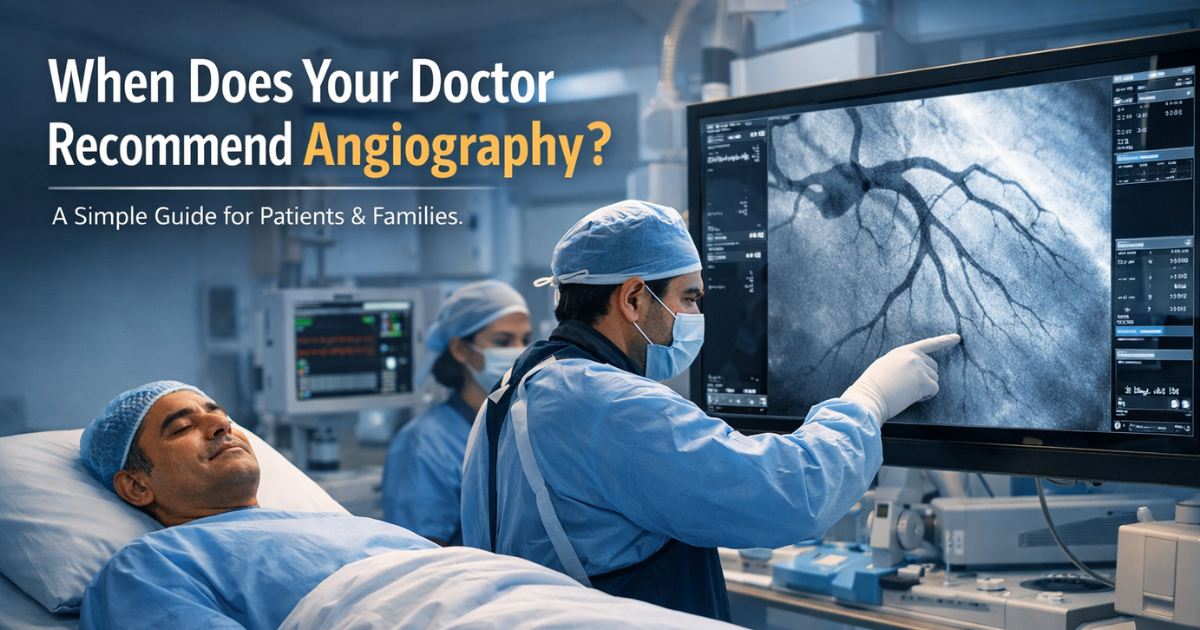
“Your doctor says you need an angiography. Your mind goes blank. Is it serious? Does it mean surgery? Will it hurt?”
If you’ve been told you need an angiography — or someone in your family has — you’re probably flooded with questions and, understandably, a fair amount of anxiety. This guide is written in plain language. By the time you finish reading, you’ll know exactly what angiography is, why doctors recommend it, what to expect, and what questions to ask your cardiologist.
What Exactly Is an Angiography?
Angiography is a special X-ray procedure that lets your doctor see the inside of your blood vessels — especially the arteries supplying blood to your heart. A harmless dye is injected to make them visible on screen. Think of it as a live “road map” of your heart’s blood supply.
The procedure is performed in a special room called a Cardiac Catheterization Laboratory (Cath Lab). A thin, flexible tube called a catheter is inserted — usually through the wrist or groin — and guided to the heart. The entire procedure typically takes 30 to 60 minutes, and most patients go home the same day.
Angiography performed on the heart’s coronary arteries is called Coronary Angiography (CAG) — the most common type you’ll hear about in India.
NABH & NABL accredited. Experienced interventional cardiologists. Advanced Cath Lab facility.
Chat on WhatsAppWhy Would a Doctor Recommend It?
Your doctor doesn’t recommend angiography casually. It’s typically advised when simpler tests haven’t given a clear picture, or when symptoms suggest a significant problem with your heart’s blood supply.
Persistent or recurring chest pain — especially during activity or stress — is the most common reason for referral to a cath lab.
During or after a heart attack, angiography is performed urgently to identify which artery is blocked and open it immediately.
If your treadmill test (TMT) shows changes, your doctor may order angiography to confirm whether arteries are narrowed.
Changes suggesting reduced blood flow or pump dysfunction often lead to angiography for a definitive picture.
Before major surgeries like valve replacement, doctors assess coronary arteries to plan the safest approach.
When shortness of breath can’t be explained by lung problems, heart artery disease is investigated via angiography.
What Do the Results Mean?
| Finding | What It Means | Typical Next Step |
|---|---|---|
| Normal / No blockage | Arteries appear open and healthy | Medicines + lifestyle changes |
| Mild blockage (<50%) | Some narrowing but blood flows well | Medication + regular monitoring |
| Moderate (50–70%) | Significant narrowing; may cause symptoms | FFR testing; medicines or stent |
| Severe (>70%) | Critical narrowing restricting blood flow | Angioplasty (stent) or bypass surgery |
| Total occlusion (100%) | Complete blockage; often cause of heart attack | Emergency angioplasty (Primary PCI) |
Finding a blockage is not the end of the story — it’s the beginning of the right treatment. Catching it through angiography often prevents a future heart attack.

Figure: Normal blood flow vs blocked artery — understanding angiography results
What Happens Step by Step?
You’ll fast for 4–6 hours. Blood tests, ECG, and allergy history are checked. An IV line is placed. You change into a hospital gown.
You are NOT put under general anaesthesia. A local anaesthetic numbs the wrist or groin. You’ll be awake and comfortable throughout.
The catheter travels to your heart. You may feel warmth or flushing when the dye is injected — completely normal, lasts a few seconds.
The cath lab team captures real-time X-ray images from multiple angles. Your cardiologist analyses these on the spot.
Catheter removed, pressure applied at insertion point. You rest for 2–6 hours. Most patients are discharged the same day.
Your cardiologist explains findings immediately after the procedure and discusses next steps — medicines, stent, or further evaluation.
Is Angiography Safe? What Are the Risks?
Angiography is considered very safe when performed at an accredited hospital by a trained interventional cardiologist. The overall risk of serious complications is less than 1 in 1,000 procedures at high-volume, accredited centres.
- Very Common Mild bruising or soreness at catheter site — resolves in a few days
- Common Temporary allergic reaction to dye — managed immediately by the team
- Rare <1% Bleeding at the insertion site requiring additional treatment
- Rare <1% Kidney stress from contrast dye — higher risk with pre-existing kidney disease
- Very Rare <0.1% Arrhythmia (abnormal heartbeat) during the procedure
- Very Rare <0.1% Stroke, heart attack, or serious vascular injury
Angiography vs Other Heart Tests
| Test | Type | What It Shows | Key Limitation |
|---|---|---|---|
| ECG | Non-invasive | Electrical activity | Cannot show artery blockages directly |
| Echo (2D/3D) | Non-invasive | Heart structure & pumping | Limited view of artery narrowing |
| Stress Test (TMT) | Non-invasive | Heart under exercise | Cannot pinpoint which artery is blocked |
| CT Angiography | Non-invasive | Artery anatomy via CT | Cannot treat blockage; radiation exposure |
| Coronary Angiography | Minimally invasive | Gold standard artery imaging | Can treat blockage in same sitting |
Questions to Ask Your Cardiologist
Understanding why the invasive route is chosen helps you know the seriousness and urgency of your situation.
In many cases, angioplasty (balloon + stent) is done in the same sitting. Knowing this in advance helps you prepare mentally and practically.
A normal result is good news, but you want to know what caused your symptoms and what the plan is going forward.
NABH-accredited hospitals follow standardised safety protocols. Equipment maintenance is a critical part of patient safety in a cath lab.
In India, diagnostic angiography costs ₹8,000–₹25,000, and with stenting ₹60,000–₹2,00,000+. Ask about government scheme empanelment at your hospital.
Need a Cardiac Consultation?
Visit Jivraj Mehta Hospital, Ahmedabad
Our experienced team of interventional cardiologists and a state-of-the-art Cath Lab are ready to give you the accurate diagnosis and compassionate care you deserve. Don’t wait — early diagnosis saves lives.
📞 +91 6357188191 · Jivraj Mehta Hospital, Ahmedabad
Life After Angiography
If done via wrist (radial approach):
A compression band is placed on your wrist for a few hours. You can use your hand normally within 24 hours. Most patients go home the same day. Avoid heavy lifting for 48 hours.
If done via groin (femoral approach):
You’ll lie flat for a few hours after the procedure. Avoid strenuous activity for 3–5 days. Watch for unusual swelling or bleeding at the puncture site.
If a stent was placed (angioplasty):
Your doctor will prescribe dual antiplatelet therapy (usually Aspirin + Clopidogrel). Do NOT stop these medicines without consulting your cardiologist — even if you feel completely fine. You’ll be enrolled in a regular follow-up schedule and cardiac rehabilitation plan.
- American Heart Association. Cardiac Catheterization. heart.org
- Mayo Clinic. Coronary Angiogram — Overview. mayoclinic.org
- NHS UK. Coronary Angiography. nhs.uk
- European Society of Cardiology. ESC Guidelines on Stable Coronary Artery Disease. escardio.org
- National Accreditation Board for Hospitals (NABH). Standards for Hospitals — 5th Edition. nabh.co
- Pradhan Mantri Jan Arogya Yojana. PM-JAY Coverage for Cardiac Procedures. pmjay.gov.in
- Indian Heart Journal. Trends in Coronary Interventions in India. sciencedirect.com
- Levine GN, et al. 2011 ACCF/AHA/SCAI Guideline for Percutaneous Coronary Intervention. ahajournals.org